
Buying vs Renting in Bangalore - Complete Guide to Real Estate Decisions 2025

Buying vs Renting in Bangalore is a major dilemma for anyone seeking to settle down in India’s tech capital. With rising property prices, evolving rental trends, and rapid infrastructural development, Bangalore’s real estate landscape has never been more dynamic. Whether you’re a young professional, a growing family, or a seasoned investor, choosing between buying and renting in 2025 requires a deep understanding of financial implications, lifestyle priorities, and future potential. This comprehensive guide is tailored to help you make an informed decision based on the latest insights into the city’s housing trends.
1. Understanding the Bangalore Real Estate Market

1.1. Current Trends in Property Prices
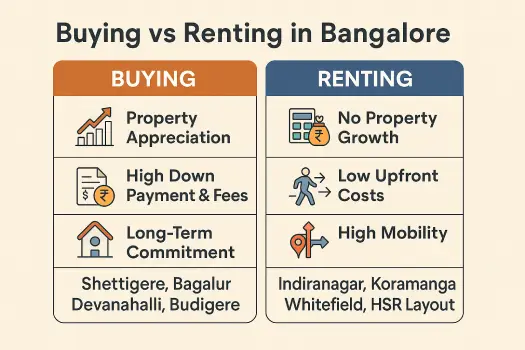
Bangalore continues to experience a healthy surge in property prices. In 2025, the average price per sq. ft. ranges between INR 18,000 to INR 22,000 in prime areas like Indiranagar, Koramangala, HSR Layout, and Whitefield. Peripheral locations such as Sarjapur, Shettigere, Devanahalli, and Yelahanka offer more affordable options, with projects like Godrej MSR City priced between INR 10,000 to INR 14,000 per sq. ft., attracting both end-users and investors. With improved infrastructure and increased demand, capital appreciation is expected to remain stable at 7%–10% annually.
1.2. Popular Residential Areas and Their Characteristics
Each neighborhood in Bangalore offers a unique lifestyle. Indiranagar and Koramangala cater to cosmopolitan crowds with upscale dining and nightlife. Whitefield and Marathahalli are preferred by IT professionals for their proximity to tech parks. Families often favor Jayanagar and JP Nagar for their established infrastructure and serene ambiance. Emerging localities like Bagalur, Devanahalli, Shettigere and Budigere are drawing attention due to metro connectivity and township developments.
1.3. Factors Influencing the Real Estate Market in Bangalore
Key factors shaping the city’s market include the expansion of the metro network, increasing job opportunities in the IT and startup sectors, government-driven infrastructure projects, and a robust influx of migrants. Bangalore’s reputation as a start-up hub and educational capital continues to boost demand for both rental and owned properties.
2. The Financial Aspects of Buying a Home
2.1. Initial Costs: Down Payment and Closing Fees
Buying a home involves substantial upfront costs. Typically, a down payment ranges from 10% to 25% of the property’s value. For a home priced at INR 1 crore, this means shelling out INR 10–25 lakhs. Additional charges include registration fees (5–7%), stamp duty, legal fees, and brokerage costs. These can collectively account for 6–10% of the total cost.
2.2. Long-Term Expenses: EMIs, Property Taxes, and Maintenance
Once you buy a home, you must factor in long-term commitments such as EMIs, which vary based on interest rates and tenure. A 20-year loan for INR 80 lakhs at 8.5% interest would amount to an EMI of approximately INR 70,000–75,000. Annual property tax, usually 0.2–0.3% of property value, and maintenance costs (especially in gated communities) further add to the monthly burden.
2.3. Potential for Property Appreciation and Building Equity
Real estate in Bangalore is still among the most lucrative in India. Property ownership not only offers a sense of security but also builds long-term wealth. Over a decade, a well-located property can potentially double in value, providing high returns on investment. Moreover, with each EMI payment, your equity in the property increases.
3. The Practicalities of Renting in Bangalore
3.1. Typical Rental Costs Across Different Neighborhoods
Renting in Bangalore is significantly more cost-effective in the short term. A 2 BHK apartment in areas like Marathahalli or Hebbal might cost INR 25,000–35,000 per month, whereas in premium zones like Indiranagar or Koramangala, the rent can go up to INR 60,000–80,000. Peripheral regions offer 1 BHK options as low as INR 10,000 per month.
3.2. Lease Agreements and Tenant Rights
Standard lease agreements span 11 months with a refundable deposit equivalent to 2–6 months’ rent. Karnataka’s rental laws favor a balanced approach, ensuring both tenant protection and landlord rights. Tenants must ensure all clauses, including lock-in periods, maintenance responsibilities, and notice periods, are clearly defined in the agreement.
3.3. Flexibility and Mobility Advantages of Renting
One of the biggest advantages of renting is mobility. Young professionals or families exploring job changes, relocation, or lifestyle upgrades can easily move without the burden of selling property. Renting also offers the luxury to live in premium locations without a hefty capital investment.
4. Lifestyle Considerations: Buying vs Renting
4.1. Stability and Community Involvement for Homeowners
Owning a home fosters stability and deeper community involvement. Homeowners are more likely to invest in neighborhood development, participate in local events, and establish long-term social connections. Children benefit from continuity in schooling and friendships.
4.2. Freedom from Maintenance Responsibilities for Renters
Renters often enjoy a hassle-free experience when it comes to maintenance, as landlords typically handle major repairs. This can be a significant relief, especially in older properties or large apartments with recurring issues.
4.3. Customization Options: Renovations and Decor Choices
Homeownership allows complete freedom over the space. From repainting walls to full-fledged renovations, you’re in control. Renters, on the other hand, face restrictions on changes and often need landlord permission for even minor modifications.
5. Long-term Financial Implications
5.1. Building Wealth Through Property Ownership
Owning property is often equated with wealth-building. Over time, the value of real estate tends to appreciate, turning the home into a valuable asset. It also offers borrowing leverage through home equity loans, should the need arise.
5.2. Investment Opportunities in the Rental Market
Rental properties are a passive income source. Many Bangaloreans purchase second homes to rent out, especially in IT corridors. With rental yields averaging 3%–5% annually, coupled with capital appreciation, this strategy has proven effective for wealth accumulation.
5.3. Retirement Planning: Owning vs Renting in Later Years
Owning a home during retirement eliminates rental liabilities and ensures housing security. Meanwhile, renting in senior years can offer flexibility and lower responsibility—ideal for those seeking a lock-and-leave lifestyle. The decision here hinges on personal financial health and lifestyle aspirations.
6. Navigating Bangalore's Infrastructure and Development
6.1. Impact of Upcoming Metro Lines on Property Values
The expansion of Namma Metro, especially Phase 2 and Phase 2B, is a game-changer. Areas like Whitefield, KR Puram, and Hebbal are witnessing rising demand due to enhanced connectivity. Properties near metro stations often enjoy a price premium of 10%–15%.
6.2. Water Supply and Electricity Concerns in Different Areas
While Bangalore faces water scarcity in some peripheral zones, established areas have more reliable supply due to BWSSB connectivity. Electricity infrastructure is largely stable, though occasional load-shedding is common in outskirts. Prospective buyers and renters must assess utility availability while shortlisting areas.
6.3. Future Development Plans and Their Effect on Housing
Government projects like Satellite Town Ring Road (STRR), suburban rail corridors, and ITSEZ developments in north and east Bangalore will greatly impact real estate dynamics. Investing near these zones today could yield higher appreciation over the next 5–10 years.
7. Legal and Regulatory Aspects
7.1. Property Documentation and Title Verification
For buyers, verifying legal documentation is crucial. This includes sale deed, encumbrance certificate, khata, and approved building plans. Engaging a legal expert for title verification ensures a hassle-free purchase.
7.2. RERA Compliance for New Constructions
Always ensure your builder or project is RERA-registered. This provides legal protection, transparency in timelines, and recourse in case of project delays. RERA-compliant projects are often seen as more trustworthy.
7.3. Rental Laws and Regulations in Bangalore
The Karnataka Rent Control Act governs rental agreements. Key provisions include fair eviction terms, notice periods, and deposit rules. Recent efforts are being made to digitize and streamline rental processes under the Model Tenancy Act.
Conclusion
Buying vs Renting in Bangalore in 2025 is not a one-size-fits-all decision. It depends on your financial readiness, lifestyle preferences, career goals, and long-term plans. While buying offers equity growth, security, and investment benefits, renting provides unmatched flexibility and lesser financial stress. Evaluate your priorities carefully and align your decision with your future aspirations.
FAQs
It ranges from INR 18,000 to INR 22,000 in areas like Indiranagar, Whitefield, and HSR Layout.
Most banks require 10% to 25% of the property’s value as down payment, plus registration and legal fees.
Neighborhoods like Shettigere, Marathahalli, Bellandur, and Electronic City offer affordable rent, proximity to offices, and good amenities.
Bangalore’s property tax is moderate, typically 0.2%–0.3% of property value, and is lower compared to cities like Mumbai.
Yes, schemes like PMAY (Pradhan Mantri Awas Yojana) offer interest subsidies to eligible first-time buyers.